100 Years of Showbags at the Adelaide Show
Free samples have been a part of the Adelaide Show almost as long as it has existed. In 1926, The Register noted that many a show-goer ‘cheerfully bore a burden, consisting of enough free samples to keep him in shaving soap and boot polish until Christmas’. Eventually, rather than handing out individual sample items, companies began to package multiple samples in the same bag, with these bags eventually becoming colloquially known as ‘sample bags’. Originally, sample bags were handed out free of charge, in the hope that show-goers would enjoy the products enough to purchased full-sized items outside of Show time. However, as far back as 1929, come vendors were selling their selections of samples for up to sixpence a bag.
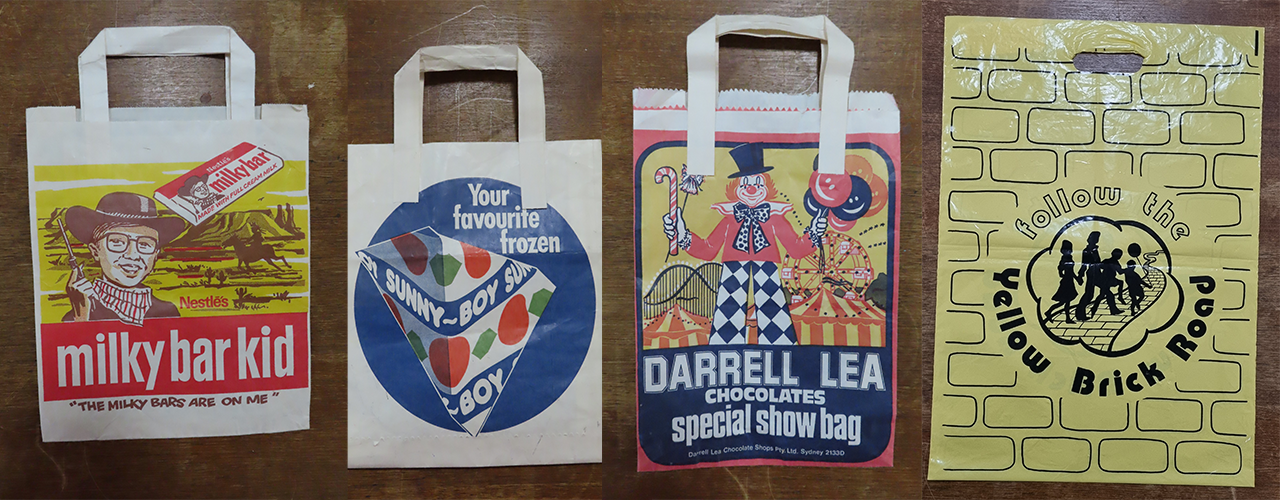
The first sample bags were simple, brown or white paper with the company logo. As time passed, the designs became more elaborate, incorporating images and colour to create a more eye-catching display. From the early 1950s, sample bags began to include novelty items in addition to genuine product samples, and it was in this post-WWII era that we also saw the shift from ‘sample bags’ to what we would now recognise as the modern ‘showbag’. Marketing campaigns shifted from the traditional focus on product samples towards popular culture, with the advent of showbags designed around film and television characters, as well as popular toys.
As showbags increased in popularity, more companies looked to get in on the action. In 1963, there were just 25 varieties of sample bags available across the Royal Adelaide Show. This number increased to 129 in 1988 and 287 in 2001, before peaking at a whopping 458 at the most recent Show in 2025. Showbags’ increase in popularity and variety also came with an inevitable increase in price, shifting from threepence-sixpence in the 20s and 30s, to 2-3 shillings in the 50s, to a record-breaking $2.50 in 1980! By 1988, the average cost of a showbag was $5. To avoid price-gouging, in 1972 the RA&HS introduced the practice of examining all showbags in the lead-up to Show, checking for any potential safety concerns and ensuring that the cost of the showbag does not exceed the market-value of the items inside.
Over the past 40 years, showbags have also seen a physical shift from paper to plastic and, following the South Australian extended ban on single-use plastics in 2025, back to paper or other reusable materials.
If you love showbags, be sure to visit the special exhibit on the history of showbags which will be on display at the Show Museum throughout the 2026 Show. Alternatively, if you’d like to experience the magic of the original ‘sample bag’, be sure to check out the iconic Yellow Brick Road trail, offering samples of local South Australian products and produce, which this year celebrates its 40th year at the Adelaide Show.
Do you have memories and memorabilia of old showbags that you want to share? Please get in touch with our Museum and Archives coordinator at history@adelaideshowground.com.au.
100 Years of Showbags at the Adelaide Show
Free samples have been a part of the Adelaide Show almost as long as it has existed. In 1926, The Register noted that many a show-goer ‘cheerfully bore a burden, consisting of enough free samples to keep him in shaving soap and boot polish until Christmas’. Eventually, rather than handing out individual sample items, companies began to package multiple samples in the same bag, with these bags eventually becoming colloquially known as ‘sample bags’. Originally, sample bags were handed out free of charge, in the hope that show-goers would enjoy the products enough to purchased full-sized items outside of Show time. However, as far back as 1929, come vendors were selling their selections of samples for up to sixpence a bag.
The first sample bags were simple, brown or white paper with the company logo. As time passed, the designs became more elaborate, incorporating images and colour to create a more eye-catching display. From the early 1950s, sample bags began to include novelty items in addition to genuine product samples, and it was in this post-WWII era that we also saw the shift from ‘sample bags’ to what we would now recognise as the modern ‘showbag’. Marketing campaigns shifted from the traditional focus on product samples towards popular culture, with the advent of showbags designed around film and television characters, as well as popular toys.
As showbags increased in popularity, more companies looked to get in on the action. In 1963, there were just 25 varieties of sample bags available across the Royal Adelaide Show. This number increased to 129 in 1988 and 287 in 2001, before peaking at a whopping 458 at the most recent Show in 2025. Showbags’ increase in popularity and variety also came with an inevitable increase in price, shifting from threepence-sixpence in the 20s and 30s, to 2-3 shillings in the 50s, to a record-breaking $2.50 in 1980! By 1988, the average cost of a showbag was $5. To avoid price-gouging, in 1972 the RA&HS introduced the practice of examining all showbags in the lead-up to Show, checking for any potential safety concerns and ensuring that the cost of the showbag does not exceed the market-value of the items inside.
Over the past 40 years, showbags have also seen a physical shift from paper to plastic and, following the South Australian extended ban on single-use plastics in 2025, back to paper or other reusable materials.
If you love showbags, be sure to visit the special exhibit on the history of showbags which will be on display at the Show Museum throughout the 2026 Show. Alternatively, if you’d like to experience the magic of the original ‘sample bag’, be sure to check out the iconic Yellow Brick Road trail, offering samples of local South Australian products and produce, which this year celebrates its 40th year at the Adelaide Show.
Do you have memories and memorabilia of old showbags that you want to share? Please get in touch with our Museum and Archives coordinator at history@adelaideshowground.com.au.